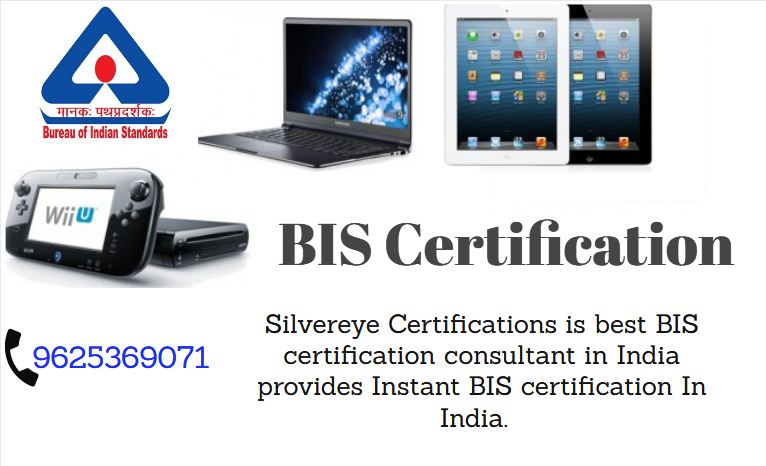
Bureau of Indian Standards (BIS) certification is provided in India by the Bureau of Indian Standards, the National Standards Body has been successfully stimulating and nurturing the standards within the country since 1947. It falls under the aegis of the Ministry of Consumer Affairs, Food and Public Distribution. It involves various activities like standards formulation, certification, testing and calibration, hallmarking etc. Its main objective is to certify the products and management systems to be safe and reliable for use by the public.
BIS product certification is one of the largest in the world covering more than 900 products. It permits the licenced users to use the ISI mark on their product, indicating the quality of products.
But not all the goods require a BIS certification, there are certain goods whose certification is optional. But there are certain goods which mandatorily require the BIS certification. There is a separate scheme for such goods known as Compulsory Registration Scheme.
CRS i.e. Compulsory Registration Scheme is a scheme and policy of the Bureau of Indian Standards (BIS). This scheme was introduced in 2012 by the Ministry of Electronics and Information Technology and BIS.
The scheme originally covered 15 products in 2012 but at present, it covers more than 50 products.
According to this scheme, all the people who are manufacturing, storing, selling, importing or distributing the goods listed under this scheme are required to apply for the BIS certification. Manufactures need to get their product tested from BIS recognised labs for applying for the certification. Once BIS registers the manufacturers, he is allowed to use the standard mark for their products in conformation with the Indian Standards.
The CRS is further divided into two classifications:
Scheme I(ISI Mark Scheme)
It includes about 107 products like cement, circuit breakers, electric iron, electric heaters, packaged drinking water, infant milk substitute etc. the manufacturers of these products need ISI certification before launching them into the market. The process of ISI certification is just like that of the BIS registration i.e. samples are sent for testing. On approval, BIS officers inspect the factory premises and on satisfaction, the ISI certification is done.
Scheme II (Registration Scheme)
It consists of about 50 products majorly including electronic items, information technology equipment, solar photovoltaic, secondary cells, batteries for photovoltaic etc. this scheme was brought in 2012 by Department of Electronics and Information Technology and BIS. It is now regulated by the Ministry of Electronics and Information Technology and the Bureau of Indian Standard.
List of Products under CRS
1)Amplifiers with input power 2000W and above
2)Electronic Clocks
3)Electronic Games
4)Laptop/Notebook/Tablet
5)Microwave Oven
6)Printers and Plotters
7)Plasma/ LCD/ LED televisions of 32” and above
8)Scanners
9)Set-Top Box
10) Telephone Answering Machine etc.
In 2012 when this scheme was introduced, it had 15 categories of electronic items and then in 2014 another 15 products was added. And according to the act no person shall manufacture, store, sell, import or distribute these goods without obtaining the certification.
Procedure for applying
Check if your product falls under the scheme.
Submit your product sample for testing at BIS recognised labs.
At the time of submission, the test report should not be older than 90 days.
Foreign applicants have to appoint an Authorized Indian Representative, in case he does not have any Liaison Office or Branch Office.
Submit an Affidavit cum Undertaking as per the guidelines of BIS.
So if you are a manufacturer of the goods covered under the Compulsory Registration Scheme, just get your certificate as soon as possible and manufacture your products in conformity with the Indian Standards.
 Silvereye Certifications